From Empty Land to Finished Goods: What the Investment Value Records
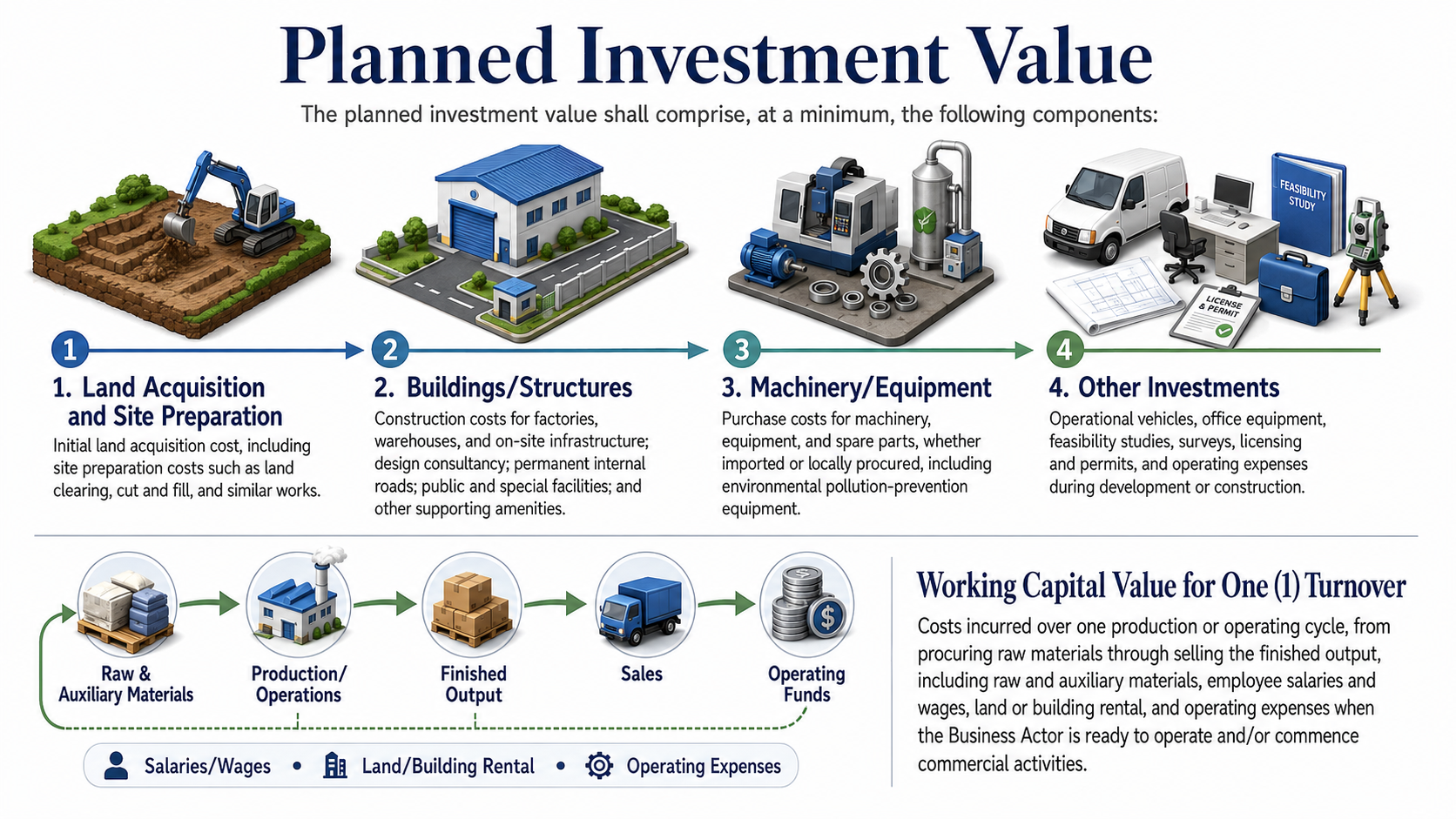
A business exists as a number before it exists as a place. Long before there are walls, machines, or a single product to sell, it first lives on a form as one figure: the planned investment value. When a company applies for its business licence online, this is the number that sums up the whole plan in a single line. It looks like a routine entry, yet many people will read it long after the form is sent.
That single line holds more than one number. As the picture above shows, it opens into the details of the planned investment value. The words "at a minimum" in the rules matter here. They come from Regulation of the Minister of Investment and Downstream Industry/Head of the Investment Coordinating Board (BKPM) No. 5 of 2025, which sets the lowest limit. A plan can carry more of these details, but never fewer than the rules require.
Read in order, these details follow one path, from an empty piece of land to goods that are ready to sell.
Land comes first. The value of land acquisition and site preparation covers the price of the land and the cost of getting it ready to use, such as clearing, cut and fill, and similar work. It is the quietest item in the budget. Nothing stands on the land yet, but everything else depends on it.
Buildings come next. The value of buildings and structures covers factories, warehouses, and the infrastructure inside the project site. It also covers design consultant fees, permanent roads inside the site, and public and special facilities. Anything built to stay, along with the cost of designing it, goes here.
Machinery comes after that. The value of machinery and equipment covers the machines and their spare parts, whether imported or bought at home. One thing people often miss: pollution control equipment counts here too. If a machine keeps the business within the rules, it still counts as a machine, even when it is tempting to record it somewhere else.
Some costs are smaller but still need a place. The value of other investments covers operational vehicles, office equipment, feasibility studies, surveys, permits, and the running costs during construction. This is the easiest item to use as a catch-all, and that is the risk. When "other" grows too big, it draws questions and shows that the costs were not sorted properly.
The detail people get wrong most often is working capital. Its planned value for one turnover pays for one full cycle of work, and that cycle runs in a set order. It starts with buying raw and auxiliary materials, moves into production, turns out finished goods, and ends when those goods are sold and the money comes back to fund the next round. Along the way there are costs that keep running, such as wages, land or building rent, and other operating costs once the business is ready to trade. The earlier details build the body of a business. This one gives it the breath to keep the wheel turning. Many plans look good on paper but forget it, and a business that cannot breathe rarely gets started.
Why be so careful about putting each cost in the right place? Because the plan comes back. A few months later it returns as the Laporan Kegiatan Penanaman Modal (LKPM), the regular investment report, where the real spending is entered under the same headings. The plan and the report tell the same story twice, first as a promise, then as proof. When the two do not match, it is the investor who has to explain a gap that did not need to be there.
There is one more reason, and it matters most to new businesses. The plan is also the way to reach fiscal incentives. The exemption from import duty on machines, goods, and materials is based on the machinery figure, because the type, number, and value of the planned machines make up the masterlist. The tax allowance is based on investment in tangible fixed assets, which means land, buildings, and machinery. Incentives inside a Special Economic Zone (KEK) also depend on the size and shape of the plan.
Two simple points are easy to forget. Many incentives have a minimum investment amount, measured against the plan. A careless entry can put a project below that amount and lose a benefit it should have had. And incentives are given based on the plan, then checked against the real figures in the LKPM. So the plan, the application, and the report need to tell one steady story.
None of this makes the form easy to fill in. In real life the numbers are often just estimates that keep changing. Even so, the planned investment value supports everything that comes later, from reporting to incentives. Filling it in carefully now saves a lot of trouble later.
Of these details, which one is understated most often? Working capital is the usual answer. We would love to hear your experience in the comments.